
Europe’s Witch Fever: 3 Case Studies
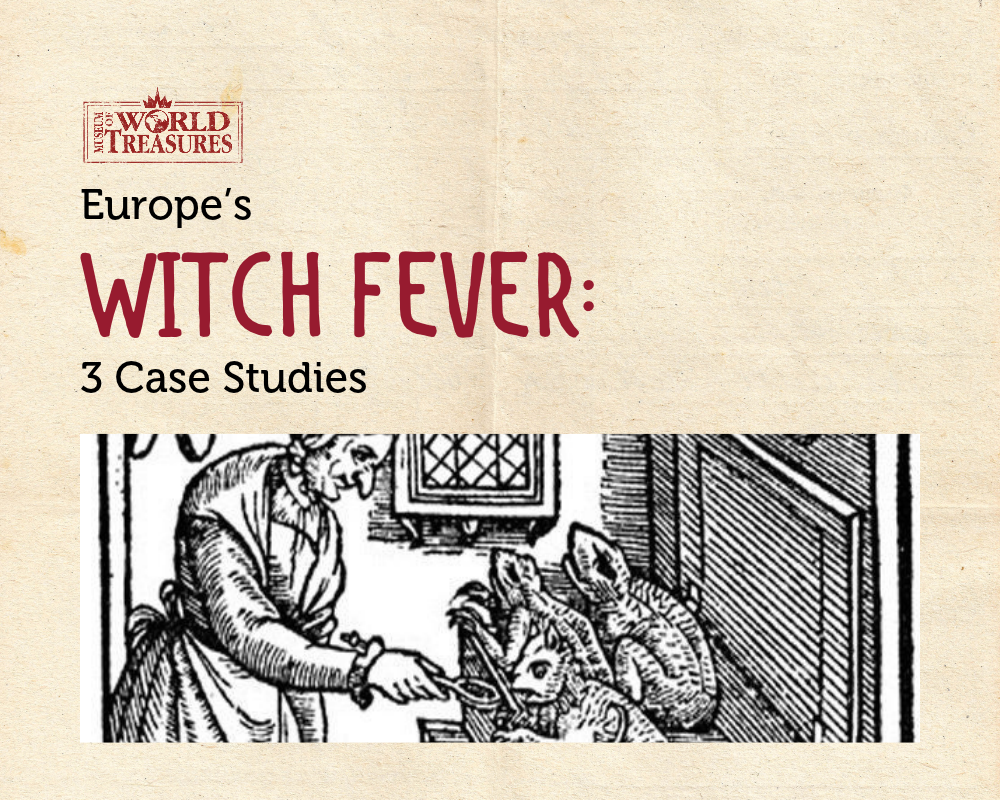
Welcome everyone to our third and final post in this series about witches in Early Modern Europe! In our first part we looked at some defining traits and characteristics of what makes a witch and where the stereotype of the witch came from. Our second entry dove into the historical context of the witch hunts and what was socially and politically occurring in Europe at this time. And finally, today, we will look at a few examples of this all playing out.
I’m bringing to the table this week three examples from the Trans-Atlantic world, one from the British Isles, one from the British American colonies, and one from the European mainland. Now it is worth remembering that with each of these examples we might not see all the traits we have discussed in our previous post, but a majority of them will apply at any one time to each example. And overall, all the examples will add up to show all that we have discussed and looked at in the previous posts.
After spending some time with each of these examples we will conclude with some thoughts about why this fever broke and I’ll direct you all to some sources and readings I have looked at over the years about this topic so that you too can delve deeper if you wish! But, before we look at our examples, if you like what we are doing here you can support the Museum here. You can also follow us on Facebook and Instagram. Or you can join our mailing list below!
Example #1: The Witchfinder-General, Matthew Hopkins
Matthew Hopkins is perhaps the most famous of all witch hunters in early modern Europe. Beginning his ‘career’ in 1644, Hopkins took full advantage of the chaos of the English Civil War (1642-1651). As war raged through England between the Royalists in support of King Charles I and the Parliamentarians, witch hunts proliferated hitting their peak in England. As we discussed in our last post, a variety of macro-scale factors played into large scale witch hunts, with destabilization of war being one of the best examples of a large-scale factor. Add in the extra communal tensions of a civil war, and England’s diverse religious landscape birthed in the Reformation and the ground was fertile for Hopkins and the like to hunt witches.
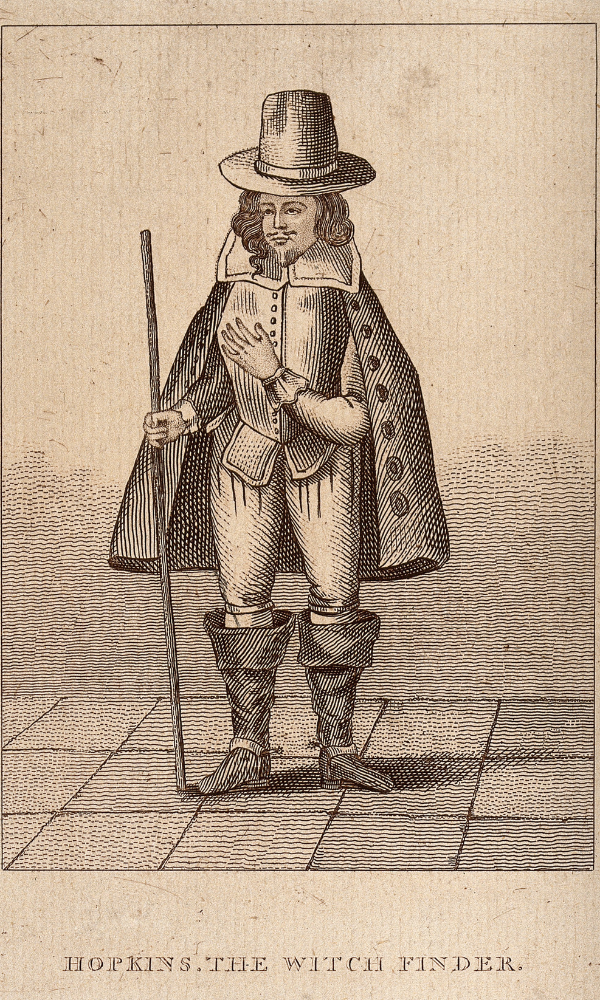
This 1792 etching by Richard Cooper from the Wellcome Institute Library depicts the man who’s actions would lead to the deaths of over 200 people, the Witchfinder General, Matthew Hopkins.
Little is known of Hopkins prior to his March 1644 appearance. Claiming the title Witchfinder-General from Parliament, which never granted said title, Mathew Hopkins led numerous witch hunts throughout East Anglia. First appearing in Manningtree, where he alleged six witches attempted to kill him, Hopkins would travel from village to village being paid to search for witches, make them confess to their crimes of witchcraft, and then have them hanged from a tree. Hopkins is, in many ways, the typical witch hunter of the times, an extrajudicial actor influenced heavily by demonologies. Many of his methods seem drawn from either the Malleus Maleficarium or Daemonologie by King James I, the latter being cited in his own book. Hopkins would derive confessions from the accused “witches” through torture (or at least ways that are indistinguishable from torture today). Torture had been outlawed in England through the Magna Carta (except under royal prerogative). Both the use of torture and Hopkins’ claim to the Witchfinder General title show him to be an “illegal” actor for a lack of a better term. So, the question, then can be raised as to why no one stopped him?
Well, the answer is simple, war. Specifically, the unique kind of chaos and disorganization that occurs with civil wars. As England was plunged into a near decade long war, authority wavered across many parts of the country. East Anglia, the part of the country Hopkins plied his trade in, was under Parliamentary control from 1643 on. However, under military control does not necessarily mean that the civil authority had its full power and influence to maintain control. As such, a rogue element, such as a supposedly Parliamentary-backed Witchfinder General, could move mostly unopposed through the country.
Example #2: The Trial of Hugh and Mary Parsons
Our second example is the trial of Hugh and Mary Parsons of Springfield, Massachusetts in 1651. While Salem might be the more immediately recognizable American witch trial, the case of the Parsons some forty years earlier shows that the conditions and mindset of the witch fever had already crossed the Atlantic. Worth noting here quickly, this section is a quick overview of the trial and for a more in depth study of it I suggest reading Malcolm Gaskill’s book The Ruin of all Witches: Life and Death in the New World.
Hugh and Mary Parsons married in 1645 in Springfield, almost a decade after the town’s founding. This town lies nearly 100 miles west of Boston, the colonial capital at the time, and the center of political and religious power. The colony of Massachusetts Bay was founded primarily for religious purposes, to give English Puritans a space free of the persecution that they received back in England. As such, the political and religious spheres were heavily intertwined. Witchcraft was ranked the third most heinous crime in the Massachusetts legal code after blasphemy and idolatry.[1] And while this town and colony lay three months travel across the Atlantic, the Puritans of Massachusetts followed closely the events of the English Civil War. Springfield itself was also founded on as much economic reasonings as religious, with its intention to be commercial profit. So already we can see the influences of the Reformation, the birth of capitalism, and war on this example.
Over the course of two years, from 1649 to 1651, Hugh and Mary Parsons are accused of various minor evil deeds by their neighbors. Eventually a turning point comes with the death of the Parsons’s infant son. Hugh Parsons had a seemingly cold and indifferent approach to his son’s death which came after a time of illness. At this point the community had begun to turn on both Hugh and Mary, believing them both to be witches. However, it is worth noting here that colonial life was difficult. And Springfield itself at this time had been dealing with a drought and less bountiful harvests. It is these kinds of stressful times that allow the fear of witches to begin to brew and ferment.
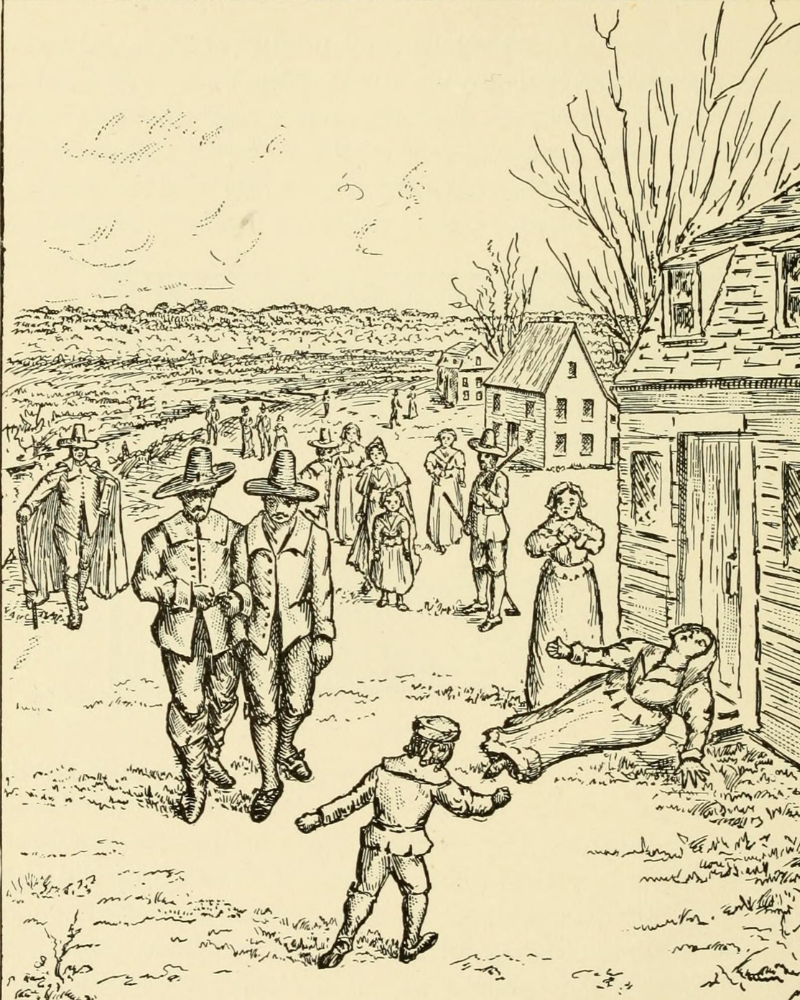
This image, from a history of Springfield written by Charles Barrows, shows the supposed witching done by Hugh Parsons.
Eventually the couple is arrested and formally charged with witchcraft. The trial, however, must take place in Boston and so Hugh and Mary are moved 100 miles away from the scene of this fever, and eventually cooler heads prevailed. While witchcraft was illegal by the colony’s legal code, the actual burden of proof was quite high. We mentioned in the last post that the centralization of the state could cause instability in local social networks, but it also ends up being an element that helps to fight against the trials we see as it helps to establish consistent legal parameters with high proofs of burden. Once the accusations of witchcraft against Hugh and Mary Parsons have been removed from its highly tense social context in Springfield, the case falls apart. Sadly, Mary dies in prison shortly before the trial begins. Hugh is found innocent and will eventually move to Rhode Island with his surviving daughter. To our modern eyes, as we read over the story of the Parsons and their trial, it becomes quite clear that Mary suffered from what we today would call post-partum depression and Hugh was just a bit of an odd fellow and social outcast, not witches.
Example #3: The Shaman of Oberstdorf
Our third example is the trial of Chonrad Stoeckhlin, a German herdsman from the town of Oberstdorf in the Prince-Bishopric of Augsburg. Just as with our second example, this example also has an excellent historical recounting and analysis in the form of Shaman of Oberstdorf: Chonrad Stoeckhlin and the Phantoms of the Night by Wolfgang Behringer.
Chonrad’s story is one that makes our modern senses question the reality of the witch hunts, but also helps to show the logic and thought process that went into what was very much a perceived reality. About two weeks before the beginning of Lent in 1578[2] Chonrad and his friend Jacob Walch, the ox herder, had a heavy night of drinking. The story goes that deep into the night, Chonrad and Jacob begin to discuss death and what happens after. Not uncommon late night drinking conversation if you ask me! But unlike most people who drunkenly delve into deep and philosophical topics, Chonrad and Jacob make a pact. Whoever dies first must come back and tell the other what death is like and what happens afterwards. And as it would happen, Jacob Walch dies suddenly about a week later. And then, on Thursday February 20, 1578, the spirit of Jacob Walch visits Chonrad while he is out in the woods gathering firewood.[3] The apparition of Walch essentially tells Chonrad to give up his drunken ways and become a proper Catholic as Walch’s spirit is stuck in Purgatory to burn off his sins. Seemingly, this works and Chonrad and his family become good Christians. However, this is where we begin to entertain the witchcraft discussions.
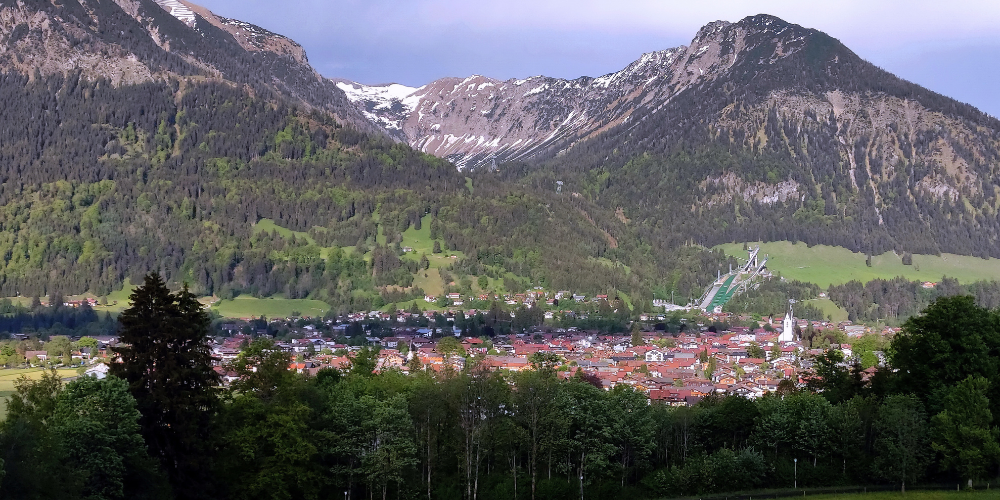
The town of Oberstdorf today. Almost 500 years ago this was the epicenter of a massive witch hunt that engulfed the whole valley.
First, by merely discussing what follows death, making a ghostly pact, and then supposedly seeing the spirit of his friend, Chonrad Stoeckhlin had at least committed heresy. The Catholic Church had already taught and maintained what happens after death, so Chonrad’s curiosity is a questioning of Church power. And in his case, a questioning of state power. Chonrad lived in the Prince-Bishopric of Augsburg, meaning his local ruler was not just a princely individual but also a Bishop of the Catholic Church. The Holy Roman Empire had a smattering of Prince-Bishoprics throughout its existence where a Bishop also held civil authority alongside being a religious authority. So, for Chonrad then, to commit a religious infraction would mean to commit a civil one as well. But this was not Chonrad’s only error. He also claimed to be visited by an angel at night who would take his soul flying through the night sky, while leaving his corporeal being at home.
Now as Behringer notes, these experiences that Chonrad has are not necessarily out of line in the Catholic tradition. However, they are usually reserved to saints and others held in high regard within the church.[4] And sadly, in the case of Chonrad Stoeckhlin, as a lowly herdsman, these experiences are interpreted as evil magic.
Come 1586 then and the Prince-Bishopric has suffered from plague and drought and societal pressure begins to raise the potential of witchcraft being present. Chonrad, with his peculiar stories of ghostly apparitions and flying through the night as a soul, is questioned by legal authorities in the fall of 1586. The jurists overseeing Chonrad’s trial were aware of and influenced by demonologies of the time, specifically in this case Jean Bodin’s De magorum daemonomania. Eventually, the jurists “uncover” a coven of witches that began with Chonrad’s own mother, Ursula Schedlerin. Now, if you remember back to our first part and Hutton’s characteristics of a witch, witchcraft is a taught tradition, and as such these accusations of witchcraft spread like wildfire through not just the town of Oberstdorf, but the surrounding mountain valley it is located in. Chonrad’s trial and execution leads to a five-year period where witchcraft trials lead to the execution of at least 150 people. Some 15-years on from Chonrad’s trial there was a peasant uprising in the region against the taxation and overreach of the civil/religious authorities.
Conclusions
So, what can we take from these three examples and the witchcraft trials of early modern Europe at large? Well firstly, I like to think all three of the examples discussed here today reflect the five causes discussed in our last post. All show at least a few of the influences of either the printing press and popular printings, religious authorities pushing their power further to combat the issues of the Reformation, the stresses of war and conflict, the instability of governmental change and centralization, or shifting economic factors due to the rise of capitalism. Secondly, we can see that the witch hunting fever of Europe’s past was a large-scale social phenomenon influenced by multiple variables.
It is also worth considering then why did these witch hunts stop? Well, just as multiple large-scale factors played into causing the fever, a few play into its ending. Possibly the biggest is the centralized state becomes the new norm. The process of centralization takes generations and that upheaval is what plays into helping to sow the social imbalance that allows witch hunts to exist. But by the late 1700s this process has essentially completed, and the rearrangement of individuals to their local governance is in a new situation that allows for some recognized stability. The new centralized state also has a different approach to the law and its enforcement. The intent and philosophy of punishment towards crimes and criminals changes and with that comes a change in how witchcraft as a legal construct changes and is addressed.[5] The economic changes faced by Europeans continues, but much of the groundwork has been laid for industrialization and capitalism that that presents a new and different set of challenges. And lastly, in my opinion, with the rise of the Scientific Revolution and the Enlightenment we see the social beginnings of a dispelling of some superstitions, such as witches. While none of these factors can singularly be attributed with bringing an end to the witch hunts of Europe, all combined they do. Anna Göldi of Switzerland is considered the ‘Last Witch’ and was executed June 13, 1782. Coming to the close of the 18th century, witch hunts in Europe had faded away. Now, this is not to say that a belief in witches disappeared in Europe, but the mass hunting and executing of them did.
I hope this has been an enlightening series of posts for you to read during this spooky season of October. This topic has become one of my favorites to read and research on for the last few years and sharing it has been a pleasure.
[1] Malcolm Gaskill, The Ruin of all Witches: Life and Death in the New World (Penguin Books, 2021), 11.
[2] Worth noting this is an imprecise date, because that is what we have. Behringer in Shaman of Oberstdorf gives us three potential dates for this actual happening, February 3, February 5, or February 6 of 1578. Ergo, about 2 weeks before Lent.
[3] Behringer, Shaman of Oberstdorf, p12.
[4] This does require then mentioning that there is a whole other conversation about magic and the perceptions of who is doing it helping to deem it either good or evil magic. For example many stories of saints and their miracles could also be seen as witchcraft, but the actor carrying out the “magic” and the intent of it very much matters!
[5] For further reading on how this change in crimes and punishment occurred look into Discipline and Punish by Michel Foucault.
